


I am an advisor, investor and educator working on climate technology and investment around the world. I am a co-founder of Riffle Ventures, and the founder of Climate Tech Bootcamp. I was also the lead author of the Climate Tech Opportunity, a global study from the Said Business School at Oxford University.
Decarbonizing heavy industry, predicting and preparing for extreme weather events, capturing carbon and other greenhouse gasses, building new insurance products, protecting food and water systems, safeguarding biodiversity, and so on and so forth.
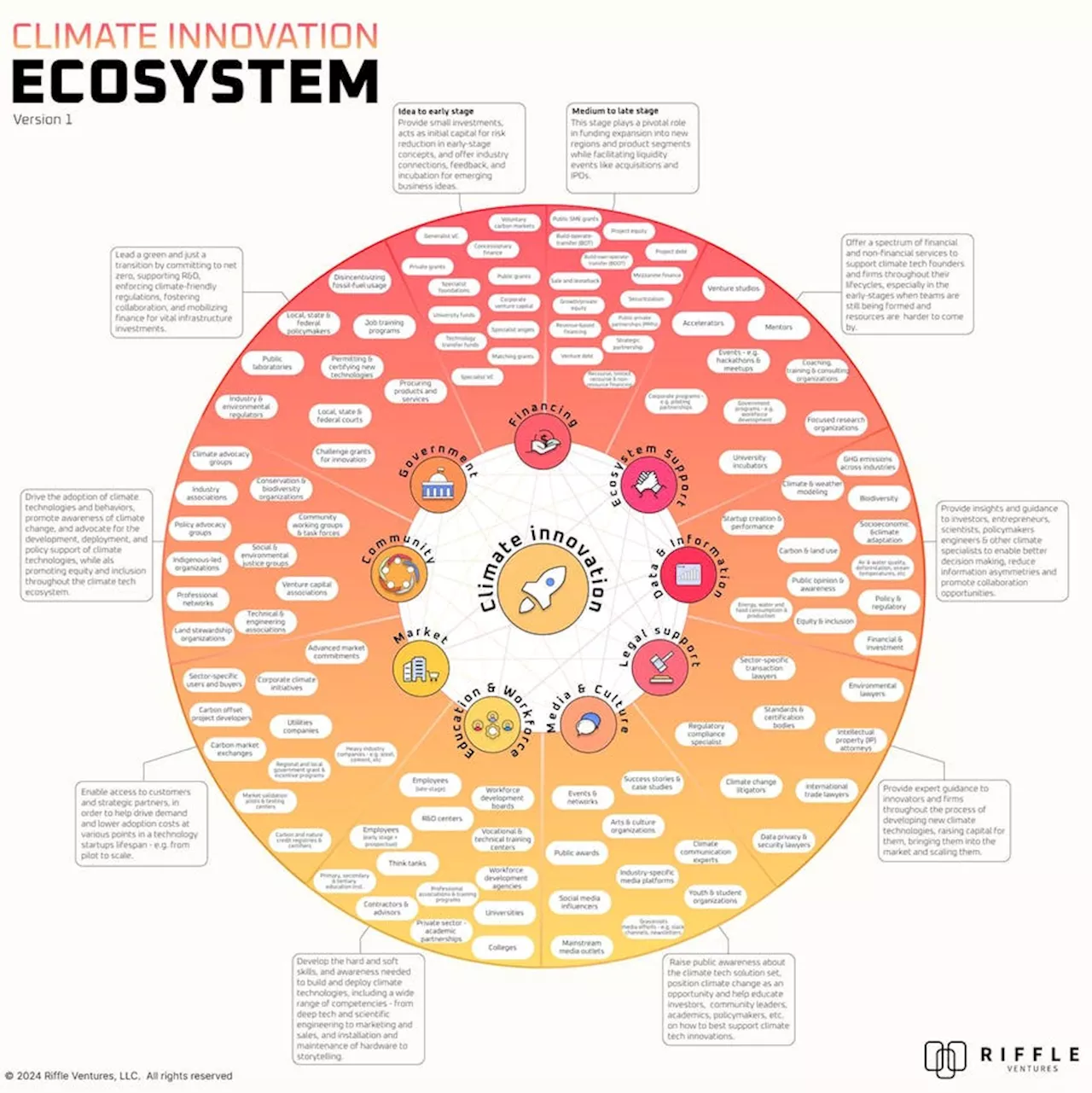
The list of climate innovation needs is overwhelming, and growing.decades researching and testing electric vehicles. Along the way, there were many cycles of public and private funding. In parallel, experts from corporate, government, scientific and advocacy domains, not to mention a multidisciplinary workforce, were behind many attempts to bring EV’s into the market. A web of institutions and individuals have to collaborate in order for climate innovations to come even close to getting into the market. The research, investment, talent, policy frameworks and incentives, as well as customer education and access needs are enormous.2050 net-zero goals, around 46% of the solutions we need are still under development or need to be built, according to the. And needs go far, far beyond creating new technologies. We need innovation around business models and sales strategies, advocacy, education, policy development and community building, among other areas. Also, the IEA’s figures do not reflect the needs for adaptation and resilience technologies—we’ll need water and agriculture, insurance and nature-based solutions in spades, often in the most under-resourced communities and countries.WWE Raw Results Winners And Grades On June 3 2024Ecosystems are a combination of individuals, institutions, policies and practices needed to nurture innovation from the ground up. They do not just deploy capital or create new companies, but help identify, support and grow innovations, develop and match talent, enable market access, create policy and provide thought leadership to guide actions, often via collaboration across many different disciplines and sectors. The schematic at the top of the article demonstrates the individuals, institutions and other assets needed to create an ecosystem.First, the range of financial instruments is wide: various types of grants and concessional funding, many stages of equity investment, debt, project finance and other forms of capital from public, private and non-profit funders all have a role. Likely, the most impactful climate tech companies will need more than venture capital to scale and stay in the market, which means that we do not need to simply mobilize more funding, but many different instruments. Second, market access is critical. Corporations and utility companies have enormous market-making power and can help open the door to customers and revenue for startups. In parallel, educating and incentivizing the market through policy, research, and community engagement are all critical to unlocking markets. Government in particular is needed to incentivize the usages of certain technologies and shape the playing field for innovations to move from idea to scale. Building a skilled labor force is critical as well, and the job needs go far beyond white collar positions—vocational institutions, for instance, can produce very skilled, valuable workers who are critical to building, installing and maintaining new technologies. Last but not least, the interconnections between all of these players is crucial. None of the individuals and organizations in an ecosystem exist in a vacuum. For example, a new technology is researched in a classroom, takes root in a university lab, moves on to an accelerator, which then hands it off to an investor who brings in strategic partners from the corporate and public sectors. These partners support with piloting, while in parallel employees from across disciplines are recruited, legal experts advise on commercialization and transaction structuring, policymakers help create an enabling regulatory environment while journalists help to tell the story. Without these relationships, as well as a continuum of support, ecosystems will hit bottlenecks and stall.Talent, collaboration and market access are the fuel that drives ecosystems. Yes, entrepreneurs start companies that build climate solutions, but legions of skills professionals and organizations behind the scenes. For example, policy makers are shaping the market, and media platforms and communities are helping to tell the story, while civil society advocates for under-represented causes and populations. Of course, this can be said for any startup, but in climate tech we are learning that this may even be more-so the case. With so much in climate tech being contingent on multidisciplinary skill sets, hardware and deep-tech development timelines, cutting through industry red tape and getting government approvals—not to mention against the backdrop of an increasingly warm and unstable planet—requires a complex mix of actors to push innovations over the finish line. While most would point to Silicon Valley as an example of an innovation ecosystem, for climate tech, ideas and opportunities have to be global.how Texas will be a prime location for the next great renewable energy innovations. Its mixture of expertise in the energy industry, alongside pre-existing hard infrastructure, workforce, universities, port access, and other assets, give it a unique combination of players and institutions that enable innovation in the energy sector. Gates’ own Breakthrough Energy has recentlyan ecosystem play in Singapore, working with government and investment institutions to help usher in the next line of high-impact climate innovation in the region., based in India, is a network of accelerator programs, funds, research, training and advisory programs that works across emerging markets. Since 2016, it has run over 80 accelerator programs, supported nearly 1,000 climate tech startups in countries including India, Sri Lanka, the Maldives and the UAE, worked with over 600 investors, and built a community of over 21,000 members in the process. It has a mandate to support over 3,000 climate tech startups across the Global South by 2025.It has been partnering with governments, corporations, think tanks and funds around the world, running everything from accelerators and funds to political delegations and research projects. Since 2004, it has operated nearly 90 startup and business support programs, mobilizing US$3.7 billion dollars in the process. Ecosystems do not simply start new companies but bring together different individuals and organizations to grow them. They educate the market, engage with governments and incumbent firms and are driven by collaborations and partnerships across disciplines and industries. Global linkages between ecosystems are essential. Climate-tech, by definition, is global, and ecosystems need to be united across geographic boundaries. Case in point:was started in New Zealand, developed in the U.S., scaled in China and now sold worldwide. This cross-border scaling does not happen without a systems-thinking approach, and we will need growth and access across countries in spades.There is a long, long road before getting anywhere close to hitting the IEA’s targets. And its numbers do not reflect the solutions needed for climate adaptation and resilience. Advanced weather forecasting, drought resilient seeds, water sanitation and other innovations will all be needed to survive in a warming planet. At the very least, understanding how innovations are made, and the collection of individuals and institutions that make up these ecosystems is an important first step. This recognition is the starting point to bringing together the necessary pieces. Organizations looking to push climate innovation forward in a meaningful way need to adopt a systems-thinking lens from day one. Fundamentally, adopting an ecosystem approach allows us to take more control over our own destiny, rather than waiting for the solution set to appear on its own. It ensures that more voices are included, helps communities align around common net-zero and resilience goals, and, most importantly, maximizes the chances that we survive. Feeling helpless in the face of climate threats is nothing new, but proactively building the environments needed for climate innovation, while daunting, provides some much-needed agency.Our community is about connecting people through open and thoughtful conversations. We want our readers to share their views and exchange ideas and facts in a safe space.Insults, profanity, incoherent, obscene or inflammatory language or threats of any kindContinuous attempts to re-post comments that have been previously moderated/rejectedAttempts or tactics that put the site security at riskProtect your community.
Texas Climate Technology Climate Venture Capital Climate Innovation Climate Entrepreneurship Startup Ecosystems Climate Startups Climate Change
United States Latest News, United States Headlines
Similar News:You can also read news stories similar to this one that we have collected from other news sources.
 Climate Tech Startups: Apply For Up To $3M In Funding From Elemental ExceleratorClean Tech News & Views: EVs, Solar Energy, Batteries
Read more »
 Kapor Capital names climate-tech vet partnerThe Oakland-based venture capital firm, which focuses on social-impact investing, added Brandon Boros to its team
Read more »
 Drone wall: NATO members to build high-tech warfare wall against RussiaNATO allies announce ambitious plan to create a drone 'wall' along their eastern borders to counter Russian aggression and bolster security.
Read more »
 Analysis-Climate lawsuits build as a Latin American court hears largest case everAnalysis-Climate lawsuits build as a Latin American court hears largest case ever
Read more »
 The Power Of B2B Partnerships: How To Build A Tech CommunityHead of Wialon at Gurtam. Read Aliaksandr Kuushynau's full executive profile here.
Read more »
 Betting Big On Climate Tech: How VCs Are Powering Climate SolutionsDasha Shunina is the Founder of Women Tech Meetup, a regular monthly event held in San Francisco, Miami, and NYC, bringing together female professionals in the spheres of technology entrepreneurship, innovation, and venture capital.
Read more »